

Introduction
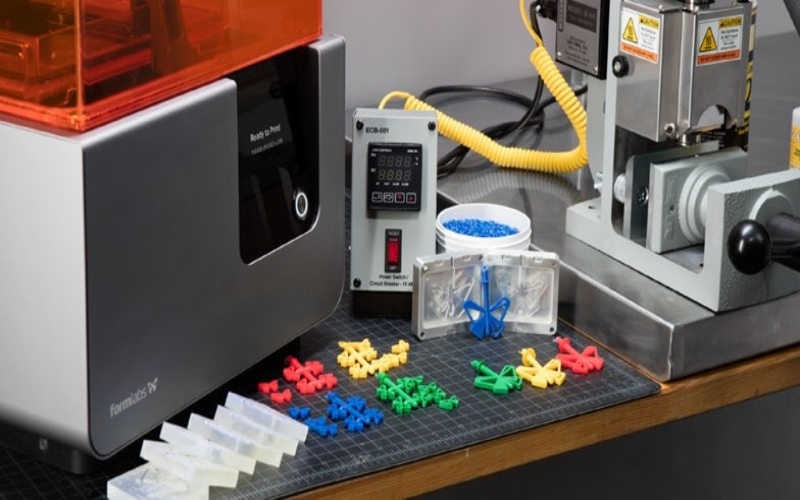
The emergence of 3D printing technology has caused significant changes in the manufacturing industry. It is challenging traditional production methods and unlocking new possibilities for product design and fabrication. One area where it impacts greatly is plastic injection molding which is an established process used for mass production of plastic components. Although plastic injection mold design has always been recognized for its cost-efficiency and efficiency in high-volume production, 3D printing offers unmatched design flexibility, viability for low-volume production, and rapid prototyping. Rather than completely replacing injection molding, 3D printing complements it as an alternative solution. For instance, it is increasingly used to create molds for injection molding, resulting in reduced lead times and costs. This convergence of technologies not only transforms manufacturing strategies but also impacts product development cycles and accessibility to production capabilities.
Historical Perspective
Injection molding was introduced in the late 19th century. It has been favored and accepted for mass-producing plastic components. Plastic injection molding is known for its efficiency, repeatability, and cost-effectiveness in large-scale production, making it a cornerstone of the mold manufacturing industry. On the other hand, 3D printing emerged in the 1980s and was initially regarded as primarily useful for rapid prototyping. Its ability to quickly create intricate designs without the need for molds made it stand out. These technologies occupied separate domains: injection molding dominated high-volume production of less complex parts while 3D printing specialized in low-volume but highly complex prototypes. However, as 3D printing technology developed, it broke free from its original domain and became a viable option for producing final products. This new capability challenged the established perceptions and intersected with injection molding in innovative ways.
III. Advantages of 3D Printing over Plastic Injection Molding
3D printing, commonly known as additive manufacturing, has many advantages compared to traditional plastic injection molding. This technology has fundamentally transformed the approaches to prototyping and production, offering captivating benefits in both fields.
- Speed and Flexibility in Prototyping: 3D printing has revolutionized the design process by enabling rapid prototyping. Designers and engineers can create and refine designs with unmatched speed. Unlike traditional injection molding, which requires dedicated molds for each design version, 3D printing allows for real-time modifications. This capability is a game-changer in reducing time-to-market for new products and facilitating quick responses to market changes.
- Customization Capabilities: When it comes to 3D printing, one of main advantages is the ability to customize product designs. In contrast, injection molding is more cost-effective for producing large quantities of identical items but has customization challenges. With 3D printing, manufacturers can easily create small batches of intricate and custom plastic injection molded products without significant setup costs. This technology empowers them to meet individual customer requirements economically, contributing to the rise in demand for personalized products.
- Reduced Waste and Material Efficiency: 3D printing operates through an additive process, constructing parts in sequential layers. This method optimizes material usage by employing only the necessary amount for each part. In contrast, injection molding often leads to wastage because of surplus materials and the requirement for trimming and post-processing. The precision of 3D printing prevents material waste, promoting more sustainable practices.
Challenges Faced by 3D Printing
3D printing has many advantages, but it also faces some challenges.
- Limitations in Material Strength and Durability: When basic desktop printers are used to produce 3D printed parts, their material strength and durability may not match that of injection-molded components. Due to the layer-by-layer production process, the printed parts can exhibit anisotropic properties, meaning that their strength varies across different directions. This variation in strength might not be suitable for applications involving high stress or critical safety requirements.
- Scalability Concerns: 3D printing is generally slower and less efficient compared to injection molding in large-scale production. When it comes to producing high volumes of parts, the time and costs associated with 3D printing can be very high. This makes scalability a crucial concern for manufacturers.
- Economic Viability for Large-Scale Production: For larger production runs, 3D printing often faces challenges when competing with the cost-efficiency of injection molding. The cost-per-part for 3D printing remains relatively constant, making it economically unviable for scenarios involving large-scale production.
How 3D Printing Complements Plastic Injection Molding
3D printing and plastic injection molding can work together synergistically to create a comprehensive, efficient, and adaptable production ecosystem.
Using 3D printing for prototyping before mass production with injection molding:
3D printing is highly effective in quick production prototypes. This enables designers and engineers to iterate and refine designs quickly and cost-effectively. Once the design has been finalized using this iterative process, injection molding can now be used for efficient large-scale production. This approach combines the strengths of both technologies: the agility and flexibility of 3D printing for design and prototyping, and the cost-efficiency, high-volume capabilities of injection molding for final production.
Combining Both for Hybrid Manufacturing Techniques:
Manufacturers are currently exploring hybrid approaches that involve combining 3D printing and plastic injection molding service in the same production line. This innovative integration allows them to leverage the strengths of both methods. For example, 3D printing can be used to create intricate internal structures for components, which can then be enclosed or processed further using injection molding techniques. Manufacturers can now produce components with complex geometries and internal structures using both technologies which would be challenging to achieve using either method independently.
Enhancing Design Flexibility and Testing:
3D printing revolutionizes the production of intricate and complex designs that were once impractical or excessively expensive using traditional methods. By utilizing 3D printing for experimentation and validation before investing in costly molds, manufacturers can embark on more daring and innovative design processes. This not only increases adaptability but also minimizes risks, guaranteeing that only the most efficient and optimized designs proceed to the mass-production stage through injection molding.
Future Outlook: Coexistence or Competition?
3D printing and plastic injection molding will likely co-exist in future. While 3D printing is progressing in terms of rapid prototyping, customization, and low-volume production, plastic injection molding remains the preferred choice for large-scale manufacturing due to its efficiency and cost-effectiveness. Companies can use 3D printing for prototyping and initial design. Afterward, they can transition to injection molding for large-scale production. This hybrid approach effectively combines the strengths of both technologies, enabling more agile and adaptive manufacturing processes.
Advancements in technology will be driven by industry demands for faster, more flexible, and sustainable production. The future of these processes might be influenced by environmental concerns as there is a growing push towards sustainable materials and manufacturing methods.
VII. Conclusion
3D printing is revolutionizing traditional manufacturing methods by providing manufacturers with unparalleled design flexibility and faster iterations for prototyping. Although injection molding remains dominant for high-volume production due to its efficiency in terms of cost and speed, 3D printing is steadily gaining traction, especially for smaller production runs and customized products. Because of its precision and design flexibility, 3D printing is mainly used in plastic injection molding for medical parts. Rather than replacing plastic injection molding, 3D printing is reshaping the entire manufacturing landscape by fostering innovation and driving towards more agile, sustainable, and customer-centric approaches.
