

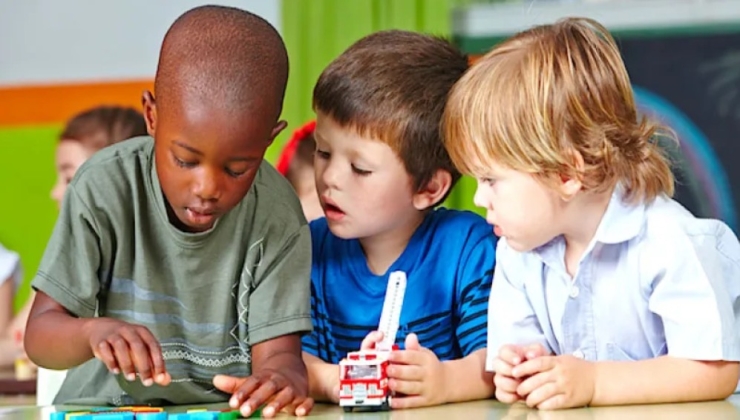
Early childhood education is essential for shaping successful individuals. Play-based learning approaches have emerged as an effective tool for developing young children’s cognitive advancement, creativity, and other critical life skills.
Play-based learning techniques foster a dynamic learning environment that encourages cognitive, social, and physical growth by integrating academic material with chances for exploration. This comprehensive method lays the basis for their academic and personal achievement.
So, how can play based learning in early childhood education have such advantageous impacts?
Cognitive Influences of Play-Based Learning
First and foremost, play based learning in early childhood education is particularly effective in two areas: executive function improvement and creativity promotion.
Development of Executive Function Skills
Critical cognitive abilities including self-control, planning, and thinking can be developed through playing. Children often involved in play-based learning are more likely to learn how to control their emotions, become resilient in the face of challenges, and think critically.
According to a neuroscience study by Liu et al. (2017), play’s repetitive element is linked to reward and memory systems that are necessary for learning and the ability to take on new tasks.
Enhancing brain connections associated with executive skills is also one benefit of these exercises.
Fostering Creativity and Divergent Thinking
Play is a low-stakes context where active participation and exploration in a safe setting help to develop higher-order cognitive abilities.
A study demonstrated that through the improvement of abilities like imagination, creativity, teamwork, and problem-solving, play promotes cognitive growth (Vartiainen et al. (2024). It promotes original idea discovery and varied thinking. Consequently, children may now try out different ideas without worrying about making mistakes.
Play based learning in early childhood education helps children to make the connection between information that they are acquainted with and information that they are not. This inspires them to solve problems creatively and come up with new ideas. This method of learning encourages flexible and open-ended thinking, which helps students think creatively.
Language and Academic Advantages Through Play Based Learning in Early Childhood Education
Apart from the cognitive advantages, play-based learning techniques also provide notable improvements in the fields of academics in young children. This will assist the children when they approach secondary school Vietnam’s curriculum and higher educational levels.
Promoting Language Development
A study (Peaslee, 2022) found that when compared to the control group, children in the play-based learning group had more progress made in their oral language development.
The study’s observations of students participating in play-based learning sessions imply that this method supports and nurtures young children’s language development.
Supporting Early Math Skills
Play based learning in early childhood education can help early math skill development as well.
Research conducted by Jayawardena et al. (2020) shows that students who participate in play-based programs have shown improved scholastic results in reading, math, and general knowledge.
Children may naturally and joyfully investigate mathematical ideas such as patterns, forms, and problem-solving via play.
Social-Emotional Gains Through Playing
Play based learning is an effective tool for young children’s complete growth as it also helps children’s behavioral and emotional development such as emotional management and interpersonal skills.
Managing Social Interactions
Early childhood education via play fosters the development of critical social skills in children, including the capacity to negotiate social interactions and peer relationships more skillfully. Children may develop collaboration, communication, and conflict-resolution skills through cooperative play activities.
Controlling Emotions
Play based learning in early childhood education aids develop social skills as well as the ability to control emotions. Through creative and expressive play, kids may investigate and process their emotions in a manner that is suitable for their developmental stage.
Developing a Sense of Self
As a component of play-based learning, role-playing and pretend play are promoted for students. Through this form of unstructured recreational activity, children may develop their independence and decision-making skills, explore several identities, and deepen their sense of self.
Promoting Emotional Expression
According to a study’s findings (Vartiainen et al., 2024), learning through playing fosters the growth of social-emotional abilities including managing relationships, controlling emotions, and creating a sense of identity.
The general social-emotional development of young kids benefits from this emotional engagement and self-expression.
Preparing Children for Future Success With Play Based Learning in Early Children Education
It has been demonstrated that play based learning in early childhood education significantly affects children’s general development. It increases language competence, fosters early math abilities, enhances social relationships, and stimulates creativity in youngsters.
Recognizing the value of play-based learning and assisting educational environments that give this approach top priority, ISHCMC offers a curriculum that incorporates the primary school Vietnam’s education system to balance student well-being and academic progress.
Apply today to guarantee a supportive and productive learning environment for your children, allowing them to be prepared for the possibilities of the future.
